Why Water Could Determine the Success of the UK's Advanced Nuclear Programme
The United Kingdom's nuclear ambitions are undergoing a fundamental transformation. After decades in which new build stalled and investment migrated elsewhere, there is now genuine momentum: the Advanced Nuclear Framework has been established, the National Policy Statement EN-7 has been published, and serious commercial progress is being made at Wylfa and Hartlepool.
Small modular reactors and advanced modular reactors are now the subject of site agreements, planning applications, and billion-pound development deals.
Yet alongside the considerable attention paid to financing, technology selection, and regulatory reform, a critical enabling question has received comparatively little examination: as nuclear shifts inland, where does the water come from?
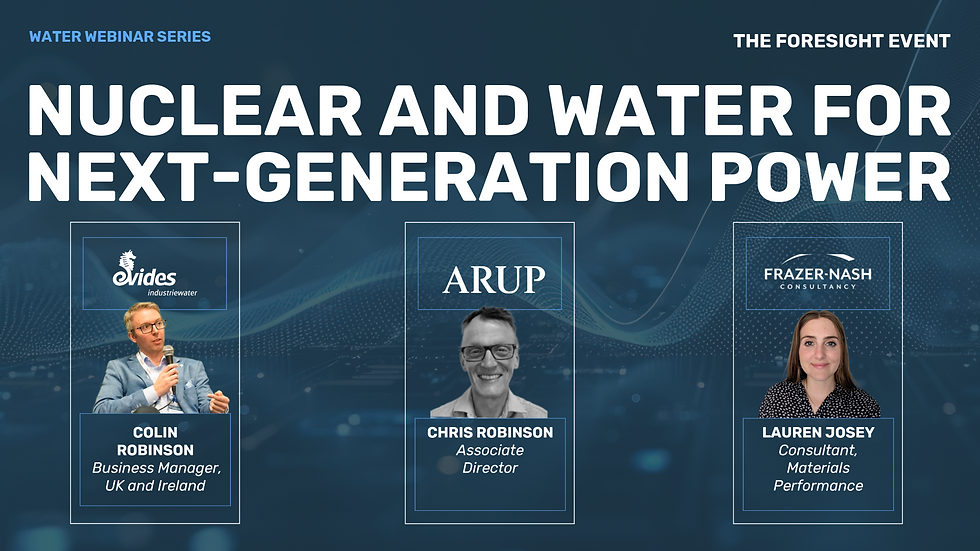
A recent webinar supported by Evides Industriewater and Arup brought together voices from across the nuclear, water, and infrastructure sectors to examine precisely this question. What emerged was a clear consensus: water is no longer a secondary engineering consideration for new nuclear.
It is a strategic constraint, and one that will shape where advanced nuclear can be sited, how quickly it can be developed, and whether it can operate reliably over its full lifetime.
A shift from the exclusivity of the Coastal Model
To understand why water has become so consequential, it is necessary to understand why it was not, until now, a significant concern. As Chris Robinson, Associate Director in the Water and Energy team at Arup, set out in his opening remarks, every nuclear power station built in the United Kingdom has been sited on or near the coast.
This was not incidental: coastal siting provided access to effectively unlimited cooling water, a solution so straightforward that it rendered the broader question of water strategy largely redundant.
The EN-7 National Policy Statement changes this fundamentally. Rather than designating a fixed list of approved nuclear sites, EN-7 introduces a criteria-based siting system, allowing developers to propose new locations, including inland sites, industrial clusters, and locations co-located with other energy infrastructure. For the first time, site suitability must be demonstrated rather than assumed.
"Water use, cooling strategy, and environmental impacts all need to be resolved early." ~ Chris Robinson, Associate Director, Arup
As Robinson noted, "Water can no longer treated as something you make fit later: Water use, cooling strategy, and environmental impacts all need to be resolved early."
This shift in siting logic produces an equally significant shift in the water challenge. Inland sites cannot draw on seawater, so they must instead compete for access to rivers, aquifers, and regional water systems.
The key is that these resources are already under pressure from climate change, environmental regulation, and growing industrial demand. The comfortable assumptions that governed nuclear water planning for sixty years are no longer available.
A Changed Water Equation
The implications of inland deployment extend beyond the simple question of cooling water availability. Lauren Josey, Consultant in Materials Performance at Frazer-Nash Consultancy, highlighted two dimensions of the water challenge that are frequently conflated but are, in fact, distinct: quantity and quality.
On the quantity side, the constraints facing inland nuclear are well understood in principle, if not yet fully integrated into planning practice. Abstraction licences on inland rivers are subject to hands-off flow conditions (requirements that abstraction must cease when river flows fall below defined thresholds).
For most industrial users, this is a manageable inconvenience. For a nuclear facility, where cooling water is not discretionary and cannot simply be reduced during drought conditions, it represents a fundamental operational risk.
"Unlike many other users, nuclear facilities can't simply reduce their water demand during periods of stress", observed Josey.
On the quality side, the challenge is less widely appreciated. Variations in water hardness, suspended solids, and biological or organic activity can affect corrosion and fouling within plant systems, with direct consequences for performance and longevity.
When SMRs are configured for combined heat and power applications - supplying steam to industrial processes such as hydrogen production or chemical manufacturing - the demand for demineralised water increases substantially. This demand profile is materially different from that of a simple electricity-generating coastal plant, and it is not yet consistently reflected in regional water resource planning.
There is a further compounding factor. There is a widespread assumption that SMRs, being smaller than traditional gigawatt-scale stations, will be proportionally lower-impact on water resources. Josey challenged this directly: where multiple units are co-located on the same site - as is expected in many cluster deployment scenarios - the aggregate water demand can approach or equal that of a traditional large-scale plant. The assumption of lower impact, she argued, needs to be stress-tested at the earliest stage of project development.
The Licensing Trap
Colin Robinson, Business Development Manager for the UK and Ireland at Evides Industriewater, introduced a further dimension of the water challenge that has significant implications for project delivery: the intersection of water infrastructure decisions and nuclear licensing.
In most industrial sectors, a water constraint identified late in the project development process is an inconvenience rather than a crisis. It may require changes to cooling system design, adjustments to abstraction strategy, or renegotiation of supply agreements.
Nuclear development does not afford this flexibility. If the cooling system design is changed once the nuclear site licence has been granted, the regulatory position may need to be revisited from the start. In a sector where licensing timelines are already a significant constraint on deployment, the prospect of regulatory restart is not a manageable risk, but potentially fatal to a project.
"There's a real risk here to the project going ahead, if you find out at the end that this water constraint exists", Robinson noted.
Water as Infrastructure, Not Constraint
The most striking contribution to the discussion came from Colin Robinson's reframing of the water challenge. Rather than treating water scarcity as a problem to be managed, he argued that the current moment presents an opportunity to fundamentally rethink the role of water infrastructure in industrial development.
The original industrial revolution, Robinson observed, was not simply a revolution in energy and manufacturing. It was, at its root, a revolution in water infrastructure. The terraced housing, factories, and urban concentrations of labour that defined the industrial age were made possible not by coal alone, but by the development of centralised water supply, treatment, and distribution systems. The investment that built those systems was not justified by existing demand, it was made in anticipation of the growth it would enable.
"We couldn't have done that industrial revolution with the water infrastructure we had at the time," Robinson argued. "We're now looking at another transition. We need to rethink our infrastructure."
The implication for advanced nuclear is significant. Well-designed SMRs, co-located with industrial clusters and configured for combined heat and power, have the potential to be enablers of water infrastructure rather than simply consumers of it.
Waste heat can support desalination; and high-temperature outputs can enable water reuse at scales and specifications that conventional supply cannot match. The nuclear facility, in this framing, becomes part of the solution to water constraint, not just an additional demand upon it.
Governance and Coordination
Chris Robinson identified the need for multi-stakeholder industry groups as a practical mechanism for driving the kind of coordination that the current moment demands. Drawing on his experience of the UK's industrial cluster decarbonisation programme, he argued that bringing together industries, regulators, communities, and developers within a shared forum creates the conditions for systematic thinking that individual project development cannot achieve.
The Cambridge Water Scarcity Group was cited as a model - a multi-stakeholder body that has brought government, industry, and water companies together to address a regional water constraint that no single organisation could resolve in isolation.
For nuclear, the equivalent mechanism does not yet exist. The regulatory landscape - spanning the Office for Nuclear Regulation, the Environment Agency, DESNZ, and regional planning authorities - is complex and, as the panel noted, not yet configured to ensure that water resource considerations are systematically integrated into nuclear siting and design decisions.
The Environment Agency's recent work on improving coordination between the water and energy sectors, and its advisory role in relation to the Strategic Spatial Energy Plan, represents a step in the right direction. But as the panel observed, advisory engagement is not the same as a planning obligation, and the risk remains that water is treated as a matter to be addressed once the more immediately pressing questions of technology, finance, and grid connection have been resolved. By which point the opportunity to design for it properly may have passed.
Conclusion: Act Now, Not Later
The central message to emerge from the discussion was one of urgency. The decisions being made now, about standardisation, siting criteria, and the integration of water resource planning into the Advanced Nuclear Framework, will determine whether advanced nuclear in the United Kingdom is built on a foundation of sustainable, resilient water infrastructure, or whether it encounters the constraints that project-by-project thinking inevitably produces.
The window to get this right is open. It will not remain so indefinitely.
As Josey put it: water cannot remain as a secondary consideration. It needs to be brought into siting decisions, design processes, and regulatory frameworks much earlier than has traditionally been the case for nuclear projects. The technology exists to do this well: the investment appetite exists to fund it.
What is required now is the institutional will to act before the problem becomes acute, rather than in response to it.

