Turning UK Net Zero Strategy into Bankable Reality
Updated: Feb 18
On 4-5 February 2026, more than 450 senior leaders from across the UK energy, industrial, infrastructure, finance, and digital sectors convened in Liverpool for The Foresight Event 2026: the UK’s leading industry-specific energy conferences dedicated to delivery, investment, and system-wide transformation of the energy sector.
Across two days of strategic keynotes, in-depth panels, and cross-sector dialogue, The Foresight Event brought together over 25 exhibitors and sponsors, including major manufacturers, nuclear developers, water sector leaders, and supply chain innovators such as Lauda, Murphy Group, Evides, Sizewell C, and Xometry.
The conference examined the delivery challenges and opportunities associated with the UK’s energy transition, industrial decarbonisation, new nuclear development, and the rapid growth of data centres and AI infrastructure.
Currently, the UK has strong policy intent, capital availability, and technological capability, however, progress is increasingly constrained by grid infrastructure, supply chain capacity, planning processes, skills shortages, and long-term policy certainty.

The Foresight Event 2026 was designed precisely to address these constraints by creating a neutral, high-level platform where industry and government can bridge gaps, align timelines, and unlock investment confidence.
Over two days, sessions were structured around the most urgent priorities facing the sector:
Day One
● Grid Stability and System Transformation
● Industrial Decarbonisation
● New Nuclear and Innovation
● Data Centres and AI Infrastructure
Day Two
● Hydrogen Market Acceleration
● Renewables and Clean Power 2030
● Energy Storage and System Resilience
Each session reinforced the need for deeper coordination between businesses, the public sector, and investors if the UK is to convert ambition into bankable, investable projects. Here are some key takeaways and discussions which emerged during the conference:
Grid Reform: Unlocking Investment at Scale
Discussions at the conference on grid stability and long-term system planning underscored a critical consensus: grid reform represents one of the most significant and necessary transformations the energy sector has faced in decades.

Colm Murphy, Director of Transformation and Major Projects, NESO
The presence of Colm Murphy from NESO was a key advantage for the attendees. His insights provided an invaluable, real-life perspective on the practical, on-the-ground steps that the network operator is actively taking. This included learning about the complex engineering challenges, regulatory hurdles, and strategic investments being made to not only maintain current reliability but also future-proof the network.
Specific topics covered included investing in advanced transmission technologies, and developing sophisticated demand-side management protocols to manage the increasingly volatile and distributed nature of renewable energy generation.
Speakers emphasised that grid reform has the potential to unlock billions in private investment provided that connection processes are accelerated and long-term spatial energy planning aligns infrastructure with regional growth.
Industrial Decarbonisation: Essential for Competitiveness
The decarbonisation of UK industry is viewed as a strategic imperative, not an optional environmental measure. Despite challenges like high energy prices and global competition, there is a consensus that a failure to decarbonise poses a risk of long-term decline for UK manufacturing and may lead to carbon leakage.
Energy-intensive sectors, including chemicals, refining, cement, food production, and glass emphasised that a multi-faceted approach is essential. No single solution is sufficient; a parallel deployment of electrification, hydrogen, carbon capture, fuel switching, and efficiency improvements is required.
Practical, scalable models, such as the regional cluster approach exemplified by HyNet, are already integrating CO₂ transport and storage, hydrogen production, and industrial fuel switching, with billions in investment already committed.
However, the primary constraint on deployment is no longer a lack of ambition, but rather concerns over policy certainty and delivery sequencing, which directly impact investor confidence. Specifically, long development timelines, regulatory ambiguity, and delayed allocation rounds are slowing down Final Investment Decisions.

New Nuclear:
The new nuclear sessions shifted focus from technology debates to delivery models. Speakers emphasised the importance of standardisation, modularisation, and community-centred development to accelerate deployment .
Small Modular Reactors (SMRs) and Advanced Modular Reactors (AMRs) were positioned as opportunities to rethink nuclear as a repeatable, product-based industry rather than a series of bespoke megaprojects .
Community engagement, social value integration, and supply chain readiness were repeatedly identified as critical success factors. Meaningful early engagement was framed not as a barrier but as practical risk management. Skills were a central topic throughout the nuclear discussions.
Data Centres and AI: From Demand Challenge to System Enabler
One of the defining discussions of Foresight 2026 centred on the rapid growth of data centres and AI infrastructure. Once seen primarily as a strain on the grid, the sector is increasingly being reframed as a potential system enabler .
However, constraints are clear. Grid access, water availability, land permits and community acceptance were identified as critical bottlenecks requiring earlier coordination between developers, utilities, and planners.
The growing power of AI represents both a structural demand driver and a transformative opportunity for regional economic growth. Bridging the gap between rapidly rising demand and infrastructure readiness will require coordinated action across all stakeholders.

Jonathan Clark, Associate Director, Gleeds
Public Sector Engagement
Day Two of The Foresight Event 2026 was opened by Bill Esterson MP, Chair of the Energy Security and Net Zero Select Committee, who framed the energy transition as one of the defining economic opportunities of the 21st century
In his opening address, he emphasised the urgent need to reduce electricity costs for households and industry, noting that high power prices remain a major barrier to competitiveness and electrification. He highlighted that lowering electricity costs is essential not only for supporting industrial decarbonisation, but also for maintaining investor confidence and accelerating the shift to clean power.
He also stressed the importance of policy certainty, long-term infrastructure investment, and clear communication of the co-benefits of the energy transition such as job creation, regional regeneration, and improved public health.
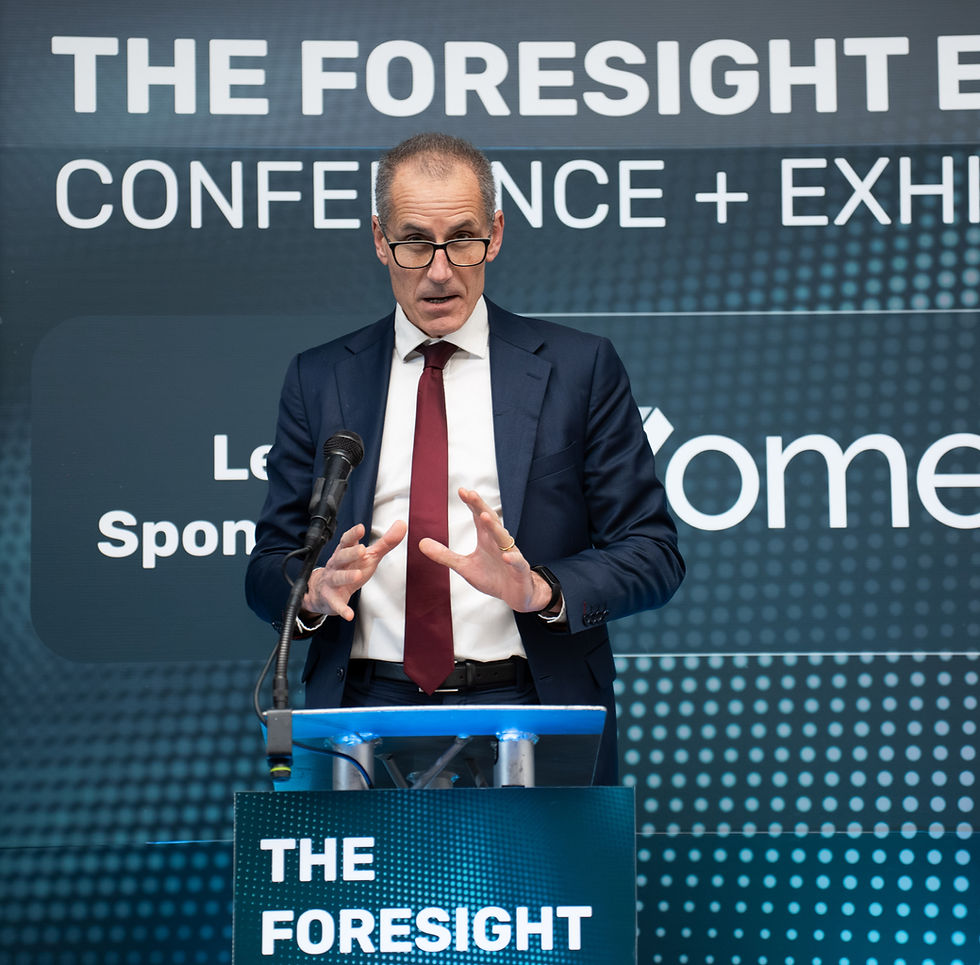
Bill Esterson MP, Chair of the Net Zero Committee, UK Parliament
Hydrogen, Flexibility and Storage: Building Market Confidence
Day Two focused heavily on hydrogen and system flexibility. Infrastructure, particularly transport and storage, remains critical to scaling beyond point-to-point projects. Secure offtake from industry and power generation is central to building confidence and accelerating Final Investment Decisions.
Clean Power 2030 modelling demonstrated that flexibility is not optional in a renewables-dominated system it is foundational. Oversupply, price volatility, and the need for long-duration storage will reshape system economics over the coming decade .
A portfolio of storage technologies short-duration batteries, long-duration solutions, and hydrogen or gas storage will be required to ensure resilience, affordability, and stability.
Bridging Business, Government and Investors
The key takeaway from all sessions was the absolute necessity of aligning the needs of businesses and government. Investors need predictable timelines, a clear pipeline of projects, and policy stability. Businesses, on the other hand, require practical necessities: access to grid capacity, a skilled workforce, and robust supply chains. For the government, the focus is on coordinated project delivery that simultaneously meets regional growth ambitions and Net Zero targets. The Foresight Event 2026 successfully provided an essential, large-scale forum for these crucial, constructive, and open discussions.
Looking Ahead: Foresight 2027 and Beyond
As the UK moves deeper into delivery mode and the sector is continuing to evolve. We are excited to expand our programme during The Foresight Event 2027.
We will remain to be one of the UK’s leading platforms for industry-specific energy dialogue, bringing together developers, supply chains, public sector leaders, and investors to turn ambition into action. The Foresight Event 2026 demonstrated that while challenges remain significant, collaboration, innovation, and coordinated delivery can unlock opportunity.


