Delivering Net Zero: Cost, Security and Certainty in the UK Energy System
Updated: Feb 18
During his opening remarks at The Foresight Event 2026, Bill Esterson MP, Chair of the Energy Security and Net Zero Select Committee, argued that the UK’s energy transition must now move decisively from ambition to delivery. He stressed the need for a sharp focus on reducing system costs, strengthening energy security, and providing long-term policy certainty to unlock sustained investment.
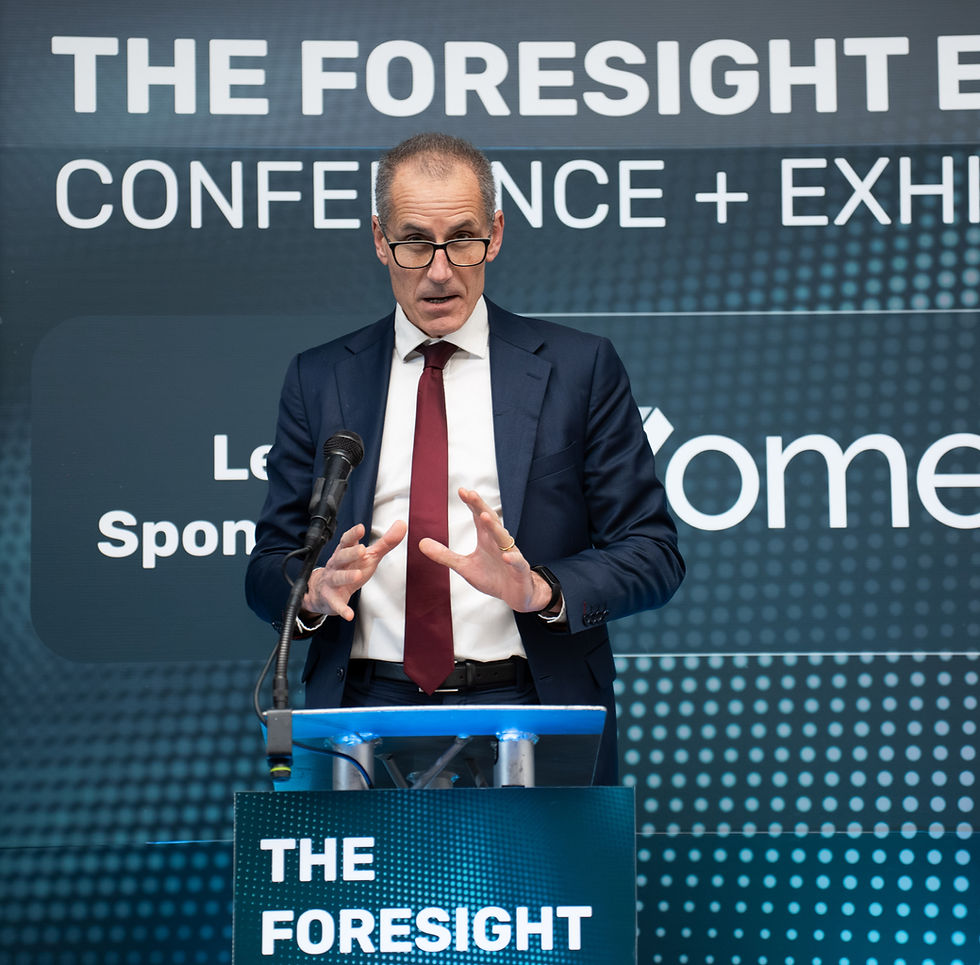
Bill Esterson MP, Chair of the Net Zero Committee, UK Parliament
Mr Esterson noted that the transition is no longer constrained by technology availability, but by delivery risk across networks, markets, and policy frameworks. Drawing on evidence gathered by the cross-party Select Committee, he emphasised that sustained investment will depend on accelerated grid connection reform, predictable deployment pipelines, and clearer long-term signals for both firm and flexible low-carbon power.
He highlighted the North West as a live test case for integrated energy system development, bringing together offshore wind, large-scale solar, nuclear, hydrogen, carbon capture, and heat networks. Progress at the Port of Liverpool—where major rooftop solar capacity is now proceeding after prolonged grid delays—was cited as early evidence that reforms to the connections queue are beginning to release previously constrained projects.
Mr Esterson reaffirmed that firm, low-carbon generation remains critical to maintaining system resilience as electrification accelerates. He reiterated the Committee’s call for a fleet-based nuclear strategy, arguing that standardisation is essential for cost reduction, supply-chain maturity, and workforce continuity. He also highlighted tidal power, including a potential Mersey scheme, as a predictable and dispatchable asset that could play a greater role in future capacity planning if supported by a clear deployment pathway.
Electricity costs were identified as the central risk to delivery and to the wider economy. Mr Esterson warned that the UK’s high power prices are undermining industrial competitiveness and slowing the electrification of heat and transport. He pointed to structural cost drivers—including network constraints and consumer energy debt—and argued that decarbonisation will fail to scale unless it delivers materially lower electricity prices for households and industry.

On heat and demand reduction, he highlighted regulated heat networks, the Warm Homes Plan, and distributed generation as essential system interventions. These measures can reduce peak demand while delivering wider co-benefits, including improved health outcomes and enhanced energy security. He also dismissed concerns around agricultural solar deployment, citing evidence that land-use impacts are limited while providing stable revenues and valuable local generation capacity.
Addressing workforce and supply chains, Mr Esterson emphasised that the transition represents an expansion of existing technical skills rather than the creation of a separate “green jobs” sector. He welcomed the Climate Jobs UK commitment as a necessary framework to support labour transition from oil and gas and gas boiler installation into roles across renewables, nuclear, networks, and low-carbon heat.
He identified political and media uncertainty as the most significant risks to investment.

Rising climate-sceptic narratives and threats of policy reversal, he warned, are increasing the cost of capital and delaying final investment decisions. Drawing parallels with the pre-Brexit period, he urged developers, investors, and public-sector bodies to engage more actively in public advocacy for the transition, cautioning that silence itself carries delivery risk.
In closing, Mr Esterson invited developers, investors, and public-sector stakeholders to submit evidence directly to the Energy Security and Net Zero Select Committee, with a focus on regulatory barriers, grid constraints, and market reform. He said this engagement is essential to bridging the gap between policymakers and business and ensuring that delivery challenges are properly addressed.
The UK's energy transition remains both investable and achievable, but only if the government and industry remain aligned on cost reduction, system security, and long-term delivery.


